7 Best Ruttl Alternatives in 2026
Ruttl's paid plan starts at $36/mo with no script trial, paid features were broken in our test, and cancellation runs through email. Seven honest alternatives.

Ruttl is a website and design feedback tool with an iframe-based free tier and a paid script-loading tier above it. Signup is easy and the free flow gets you commenting in minutes — for one-off, iframe-style reviews it works fine.
Three recurring issues drive paid customers to look for an alternative:
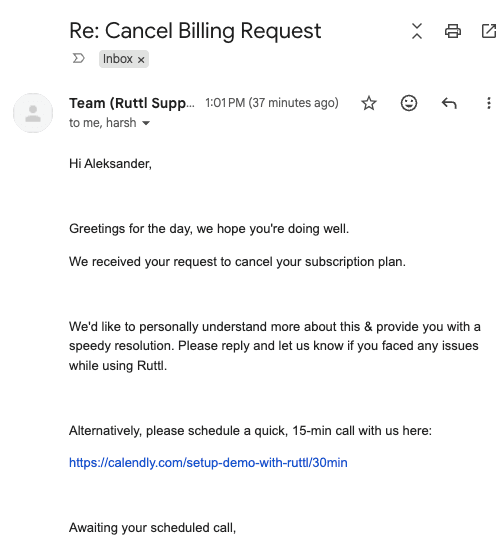
- Cancellation is not self-serve, in conflict with EU consumer law. Billing runs on Stripe, but Ruttl does not expose a Stripe customer portal. Cancellation is by email only, and the reply routes the request into a meeting instead of completing the cancellation. Under the EU Consumer Rights Directive (2011/83/EU), unsubscribing must be as straightforward as subscribing — Ruttl's flow does not meet that standard. Public reviews repeat the same pattern: customers report submitting a cancellation and being charged again the following month.
- Refund refusal in conflict with EU withdrawal rights. The EU's statutory 14-day right of withdrawal applies to digital subscriptions purchased by EU consumers. We exercised it during testing and the request was initially refused; the refund was only granted after sustained back-and-forth, not as a matter of policy.
- No trial of the paid script tier, and broken paid features in testing. The script integration — the feature most teams actually want — cannot be evaluated without paying first. The plan starts at $18 per seat with a two-seat minimum, a $36/mo floor. Once paid, script loading threw errors in our testing and every ticket bounced. Confirming the importance of free trials.
These are not good practices, and the practical takeaway is that you want some alternatives — ideally ones that put you in a stronger position from day one. Not every alternative on this list ships all three, but at least one will line up with what matters most to you:
- An EU-based vendor, so consumer protection law is on your side without a fight
- Self-serve cancellation through a Stripe customer portal — no email loop, no meeting request
- A free or card-free trial of the paid feature set, so you can verify the tool works before committing
The bullets above are about trust and conduct, not features. On the product side, Ruttl does a couple of things genuinely well, and most teams leaving still want to keep them:
- Iframe loading is fine for static review — staying on that model is a valid choice if it has worked for you
- Easy client onboarding — drop a link, leave a comment, no signup ceremony
For those reasons, these are the alternatives worth shortlisting first.
Simple Commenter#
Built for: Agencies · Freelancers · QA teams · SaaS teams
Best for: Agencies and SaaS teams who want non-technical reviewers to comment without signing up, while still giving the team a real dashboard, integrations, and a deep WordPress story.
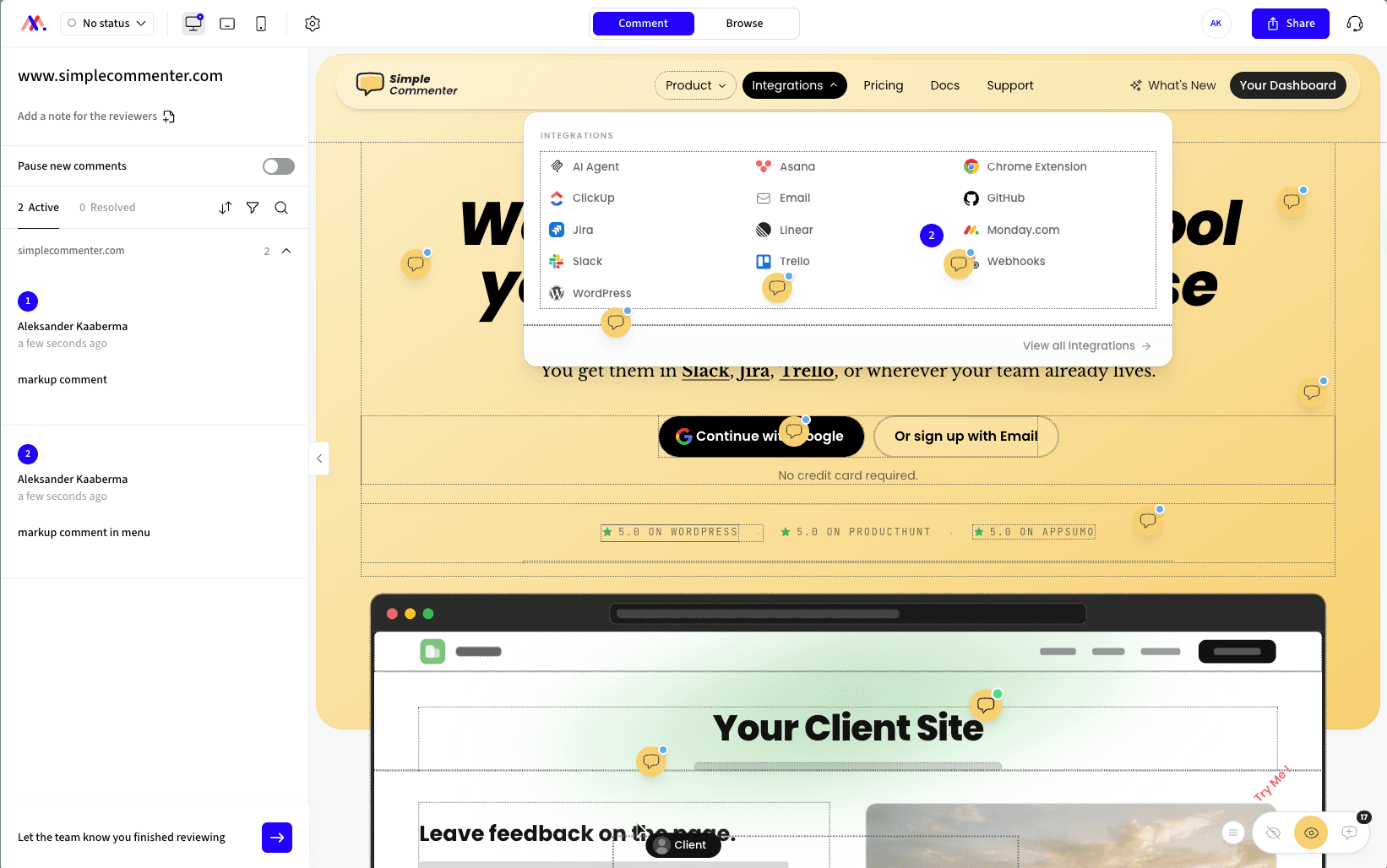
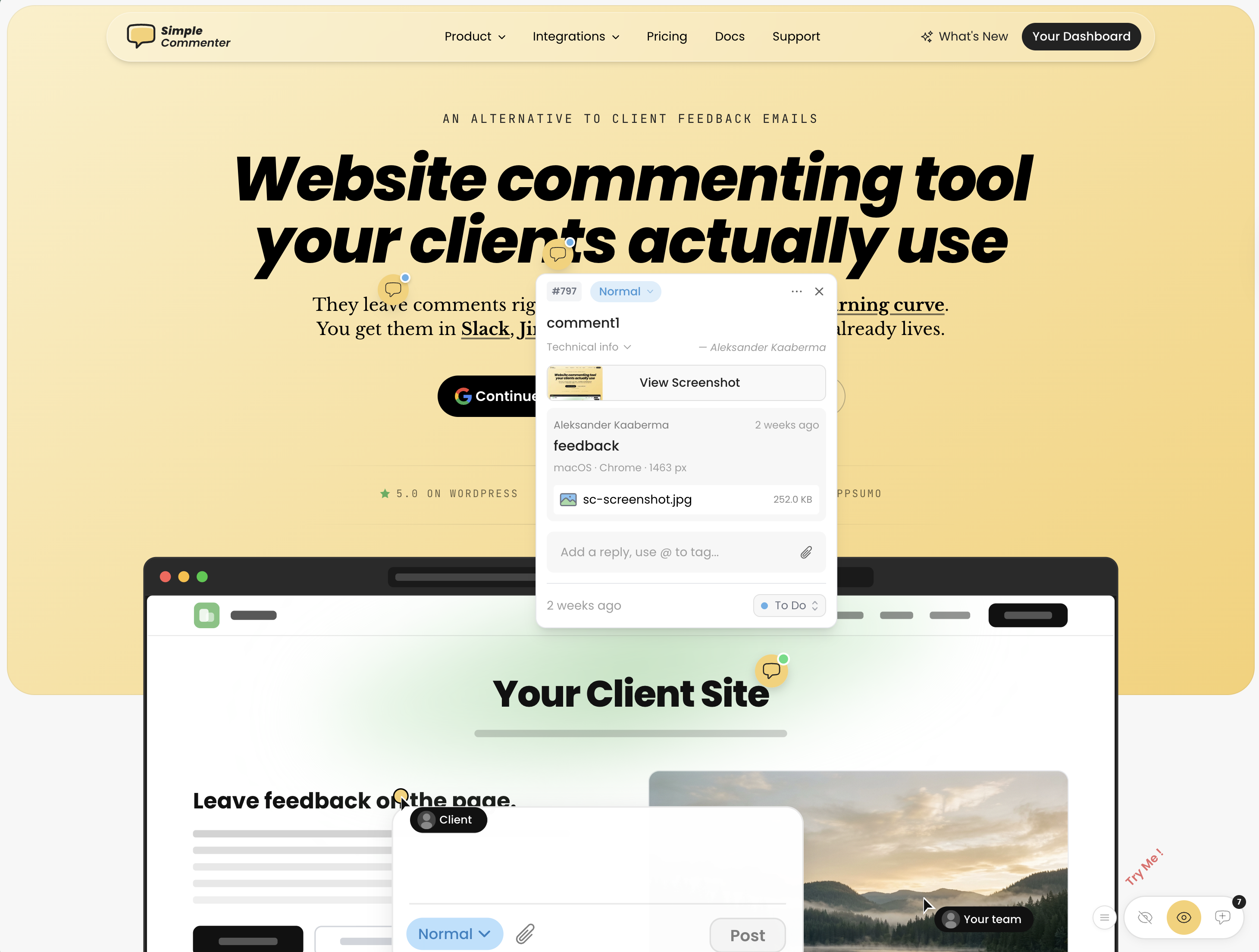
Simple Commenter is built around one idea: a non-technical client should be able to drop feedback on a website without signing up, installing anything, or learning a new tool. Click a spot, type, send. No account creation, no browser extension, no walkthrough. The rest of the platform is layered on top of that single foundation.
For longer engagements that need more structure, clients can sign up in two clicks or get invited into a dedicated client portal. Once invited, each comment is named, threaded, and they get a notification the moment you reply. Same low-friction surface — with the structure a reviewer needs once a project is actually moving.
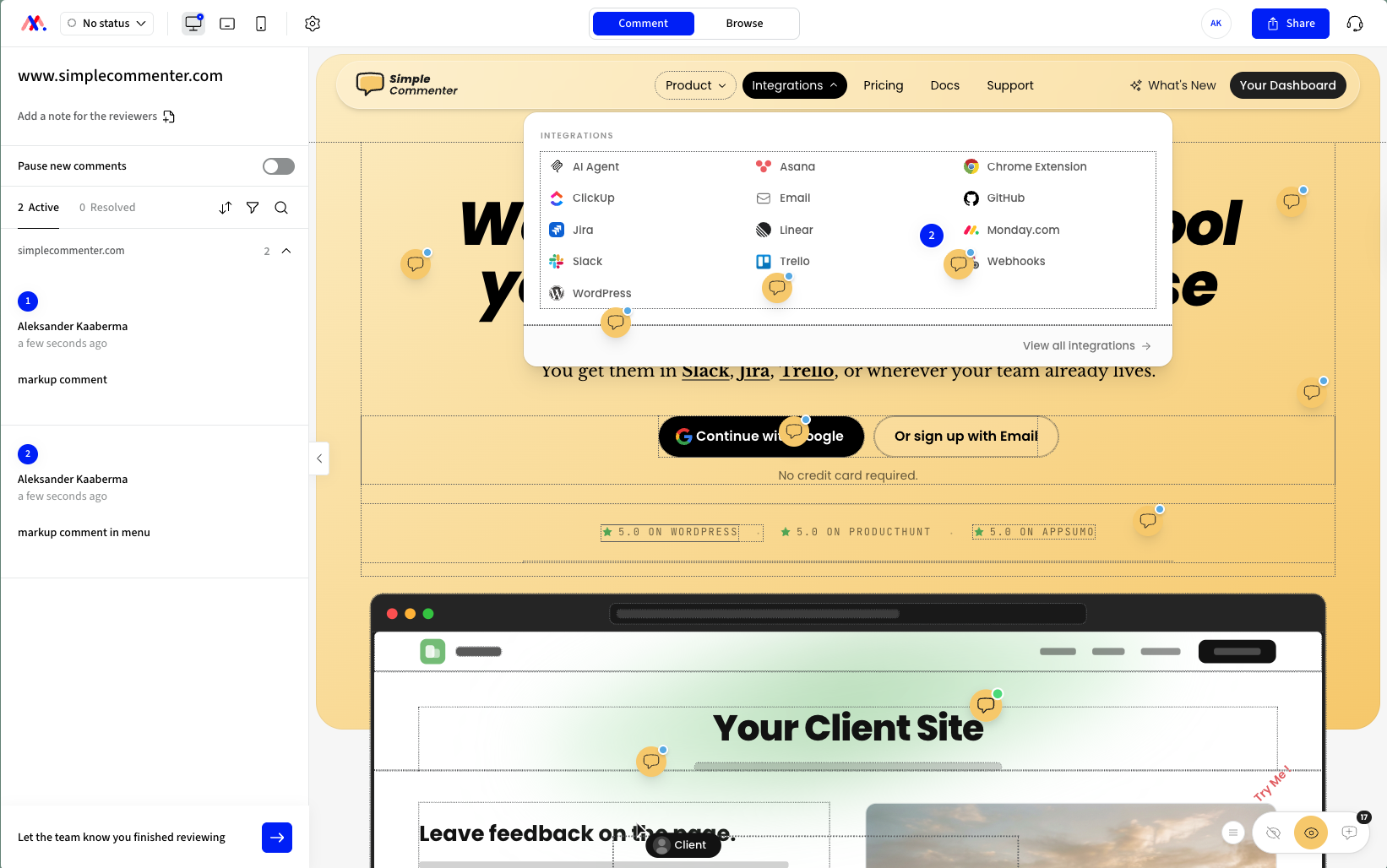
On the team side, members log into a shared dashboard where feedback pipes straight into the rest of the stack. The integration list covers Slack, Trello, Asana, ClickUp, Linear, Jira, Monday, GitHub, email, and inbound or outbound webhooks, plus a native MCP server that lets Claude Code, Cursor, and other AI agents read and reply to comments directly.
The widget loads on every kind of page — marketing sites, SaaS apps behind a login, staging environments, and WordPress. Access scales with the use case: open for public collection, token-gated for staging, login-gated for client work, or SSO auto-login for SaaS teams whose internal reviewers are already signed into the product.
Against Ruttl specifically: $34.99/mo Agency for 10 seats vs Ruttl's $36 floor for two, a 14-day card-free trial of the script tier (Ruttl has none), and self-serve cancellation through Stripe instead of an email loop with a meeting request attached.
Key features:
- No-signup commenting — clients pin and reply without creating an account
- Optional client portal with invitations, named comments, and reply notifications
- Script-based widget that works on SaaS apps, staging, and marketing sites
- Three access modes — open, token-gated, login-gated — plus SSO with auto-login from your own site
- WordPress plugin with full in-WP management of comments, members, replies, and settings
- Integrations with Slack, Trello, Asana, ClickUp, Linear, Jira, Monday, GitHub, email, and webhooks
- Read, search, organize, and export feedback with your AI through the MCP integration
- Chrome extension for reviewing sites you do not own
- Automatic screenshots, file attachments, PDF and image review
Pricing:
- 14-day free trial, no credit card required
- Agency $34.99/mo (10 users, integrations, automatic screenshots, custom themes, 50 GB storage, 500 MB per file)
- Business $149.99/mo (25 users, 500 GB storage, 5 GB per file, SSO, custom domain, custom email domain, whitelisting, priority support)
- Enterprise custom (unlimited users and projects, SSO/SAML, advanced permissions, dedicated CSM, API user provisioning, SLA)
- 2 months free on annual billing
Pros:
- Lowest client friction in the category — no signup, no install, no tutorial
- Optional client portal when you do want named, notified, structured feedback
- Works on every page type: marketing, SaaS behind auth, staging, WordPress
- Only tool on this list with native in-WP comment management
- SSO and auto-login from your own site — internal reviewers never see a separate login
- Per-plan seats instead of per-seat pricing — adding clients does not raise the bill
Cons:
- Lacks full project management features like boards or kanban — feedback flows into your existing PM tool instead
- Newer to the market than BugHerd or Marker.io, so the integration list is still expanding
Reviews:
Simple Commenter holds a 5.0 average across Product Hunt and AppSumo, with 600+ agencies, freelancers, and enterprises running it in production. The line that comes up most often in customer reviews is the no-signup flow — variations of "finally, a feedback tool my clients actually enjoy" and "life changed in under 5 minutes" appear across dozens of testimonials. Web professionals who switched off Markup, Pastel, and BugHerd repeatedly mention how much faster review cycles run once the login step is gone — a Jim Langman review describes a stalled year-long project that launched three weeks after Simple Commenter dropped in. The most common feature request is a kanban-style board, which lines up with the trade-off above: this is a feedback widget, not a PM tool. Support response time is the second-most-praised aspect; "fixed my issue in literal seconds from emailing them" shows up across multiple reviews verbatim.
Feedbucket#
Built for: Agencies · QA teams · SaaS teams · In-house product teams
Best for: Teams that want feedback to flow straight into a project management tool. Less ideal if you want a self-contained dashboard for triaging feedback.
Feedbucket installs through a script tag, with one-click installers for WordPress and Shopify on top. Script-based loading is the most flexible install method in this category, and Feedbucket gets it right. The WordPress plugin is a clean script installer and nothing more — there is no in-plugin dashboard for members or settings, which is a deliberate trade-off. The contrast is Simple Commenter, where the WordPress plugin lets you manage comments, members, and settings from inside WP admin.
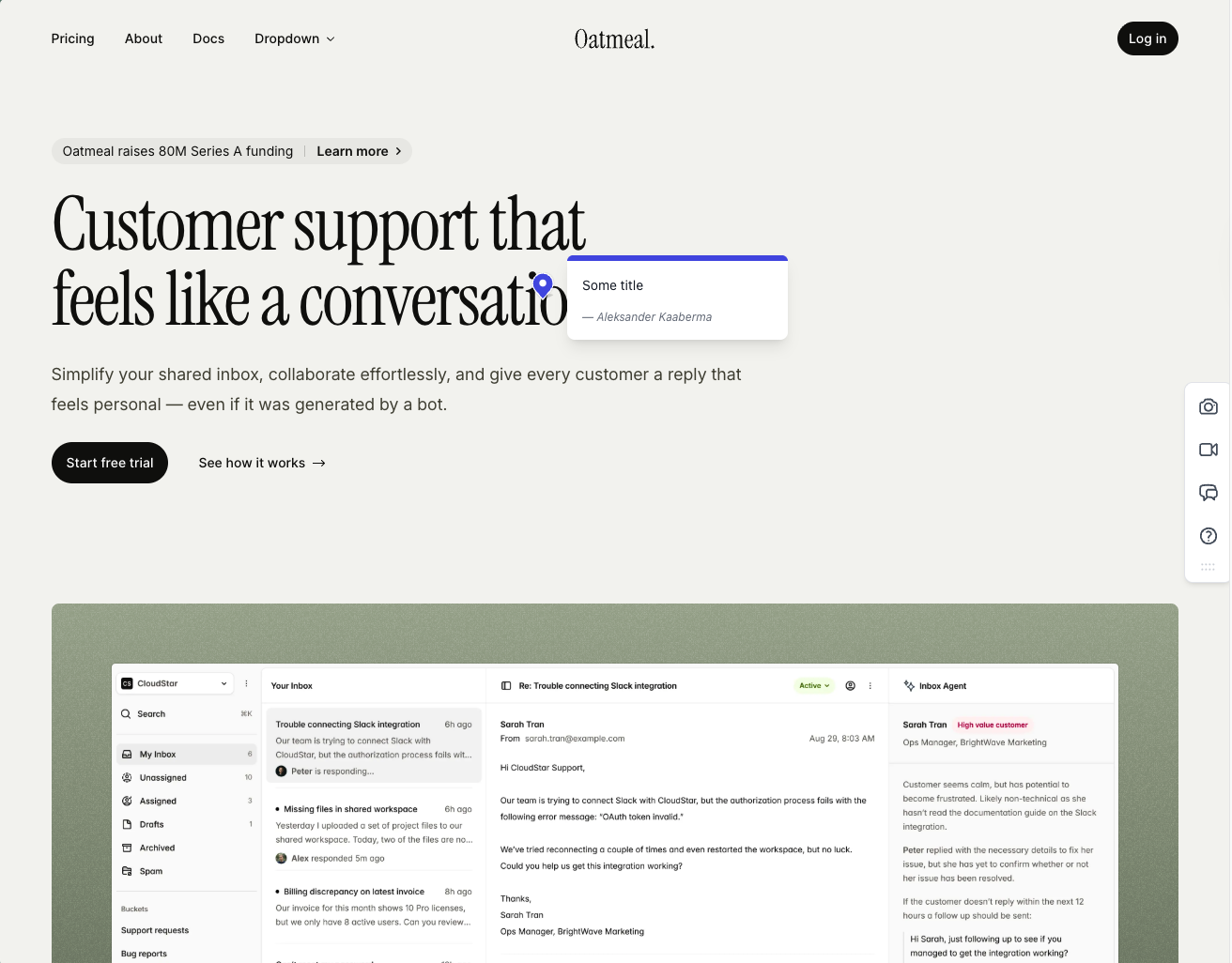
Onboarding is one of the cleaner flows we tested. Clients don't have to sign up, every comment captures an automatic screenshot, and the screenshot is pinned to the exact spot the comment was placed.
The integration pool is one of the deepest in this category. Pretty much every PM tool you'd want feedback to land in is supported, and the entire workflow is built around that handoff. Feedbucket is positioned as a layer between your site and your tracker, not as a replacement for it. The dashboard reflects that decision. You can filter by tags and page, but there is no built-in priority, ordering, or board view. If you live inside Jira or Trello, that's fine. If you wanted Feedbucket itself to be the home for triaging feedback, it'll feel thin.
One quirk that shows up in reviews and matched our testing: every comment requires a title by default. It's an irritating extra step for clients who just want to flag a misaligned button in passing.
A few other limits to know. Customization is light unless you upgrade, and if you live in WordPress, Simple Commenter offers a deeper in-WP experience with full member, settings, and integration management inside the admin. Outside those nitpicks, this is one of the most functionally complete tools we've tested. Fair pricing, accurate screenshots, and a real integration story — and a 14-day card-free trial that solves the exact "test before you pay" gate Ruttl puts on its script tier.
Key features:
- Script-based installation with one-click installers for WordPress, Shopify, and other major platforms
- Automatic screenshot capture, pinned exactly where the comment was placed
- Video feedback and screen recordings on every plan
- Wide integration pool covering most major PM tools
- No client signup required, guests can comment via a link
Pricing:
- Pro $39/mo (5 team members, unlimited reporters, screenshot and video feedback, integrations)
- Business $89/mo (25 team members, console logs, JavaScript API, custom branding, custom metadata, data export)
- Enterprise $259/mo (dedicated success manager, priority support, pay by invoice, SSO coming soon)
- 20% discount on yearly billing
- 14-day free trial, no credit card required
Pros:
- Clients don't need to sign up to leave feedback
- Screenshots are accurate, pinned to the right spot, and generated quickly
- Wide integration pool with pretty much every PM tool you'd want
- One-click installers for WordPress, Shopify, and other CMS platforms
- 14-day trial with no credit card asked up front
- Fair price for the feature set
- Developed in EU
Cons:
- Title field is mandatory by default on every comment (can be turned off, but it is on out of the box)
- Native dashboard is limited: filter by tags and page only, no priority or ordering
- WordPress plugin is a pure script installer with no member or settings management inside WP
- Customization options are light unless you upgrade to Business
- Built around piping feedback into a PM tool, not as a standalone home for triaging
Reviews:
Public reviews skew strongly positive and match what we saw in testing. Two themes come up most often: the no-signup client flow and how reliable the tool feels day to day. The "bug-free" experience gets repeated a lot, which is rarer in this category than you'd expect — and stands in sharp relief against Ruttl's "screenshot capture threw errors" testing notes. Integration depth is the other recurring praise — teams who already live in Jira, Trello, or Asana describe Feedbucket as the missing layer between their site and their tracker. Criticism is light and lands on the same nitpicks we hit: a thin dashboard and limited customization below the top tier.
Pastel#
Built for: Freelancers
Best for: Solo creators reviewing static design deliverables. Hard to recommend for live-website feedback in 2026.
Pastel has been around since 2016, making it the senior tool on this list. That tenure cuts both ways. The product is mature and the UI is polished, but the workflow hasn't really kept up with what "website feedback" means today. Reviews say it works once a canvas is set up, and that's technically true. The harder question is whether the workflow Pastel locks you into is the one you actually want.
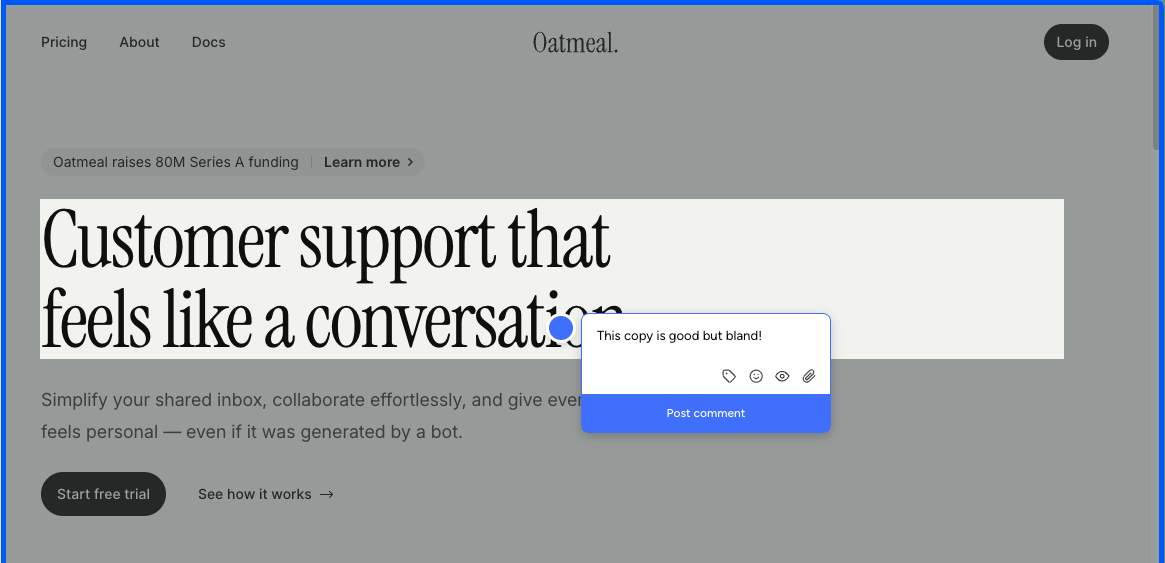
Setup is the easy part. Drop a script tag into your site or use the Chrome extension, and Pastel generates a "canvas" — a Pastel-hosted URL that frames a snapshot of the page. Reviewers leave comments inside that canvas, not on your live site. The Chrome extension doesn't change this; it only spins up a new canvas from whatever page you're on. There's no on-page commenting like Simple Commenter or BugHerd offer.
The iframe model has a hidden cost most teams discover only after committing: you can't actually submit feedback from a real mobile device. Mobile review runs through a desktop-emulated viewport inside Pastel, and anyone who's done QA knows emulated mobile and real mobile behave differently. Touch handlers fire differently, fixed positioning misbehaves, modals jump, and a meaningful share of the bugs you'd want clients to flag will never surface in the emulator. For a website feedback tool in 2026, that's a hard limitation.
The free tier carries another constraint that's easy to miss until you hit it: a 72-hour commenting window. Once a canvas is sent, comments automatically close after three days. Some teams use this as a forcing function for clients who otherwise drag reviews out for weeks. For most teams it just means spinning up a fresh canvas every time a stakeholder needs another day.
Pricing reinforces the gap. Free Forever is generous on guest reviewers but capped at 1 active canvas with the 72-hour window. Pro at $35/mo lifts you to 3 canvases and 2 users — and that's about all you get. No integrations, no webhooks, no Trello, Asana, Jira, or Zapier. Those are locked behind Team at $119/mo. At the $35/mo price point, you can find tools that ship integrations, embed on the live site, and let clients comment from an actual phone. Pastel charges the same money for noticeably less.
Key features:
- Iframe-based feedback canvases hosted on Pastel
- Asset feedback on images and PDFs, not just live websites
- Script-tag installation
- Chrome extension to spin up new canvases
- File attachments and user mentions in comments
- Unlimited guest reviewers on every plan
- Project spaces, labels, and private comments
Pricing:
- Free Forever $0/mo (1 user, 1 active canvas, 72-hour commenting window, unlimited guest reviewers, 2 GB video)
- Pro $35/mo (2 users, 3 active canvases, CSV export, 100 GB video, no integrations)
- Team $119/mo (starts at 5 users, $24/user after, unlimited canvases, Trello/Asana/Jira/Zapier/webhook integrations, 500 GB video)
- Enterprise $450/mo (starts at 10 users, $45/user after, SAML SSO, SOC 2 report)
- 14-day free trial on all paid plans
Pros:
- Pin comments on images and PDFs, not just live sites
- Mature product, around since 2016
- Fast setup with a simple script tag
- Unlimited guest reviewers on every plan
Cons:
- Iframe-only feedback: reviewers comment on a Pastel-hosted snapshot, not your live site
- No real-device mobile feedback. Mobile review is a desktop-emulated viewport, which behaves differently from an actual phone
- 72-hour commenting window on the free tier closes comments automatically after three days
- Chrome extension only creates new canvases; it is not an on-page commenting tool
- Integrations are locked to the $119/mo Team tier; nothing on Pro
- Pro tier feels thin at $35/mo against tools at the same price that include integrations and live-site embedding
- Hard 3-canvas cap on Pro means active projects compete for slots
Reviews:
Pastel reviews skew positive on the basics. Setup is fast, the canvas concept is easy to grasp, and once a reviewer is inside the canvas the commenting itself is fine. The criticism shows up at the edges of that workflow. Clients balk at opening a separate tool to leave feedback. Stakeholders who don't get to a Free canvas within 72 hours hit a closed window and need a fresh link. Anyone trying to test on a real phone gets funneled into a desktop-emulated viewport. None of these are dealbreakers for solo creators reviewing static deliverables, but they stack up fast for teams running live-site reviews in 2026.
Userback#
Built for: In-house product teams · QA teams · SaaS teams
Best for: General visitor feedback on live websites, or internal QA on staging sites at larger companies. A weak fit for client review rounds.
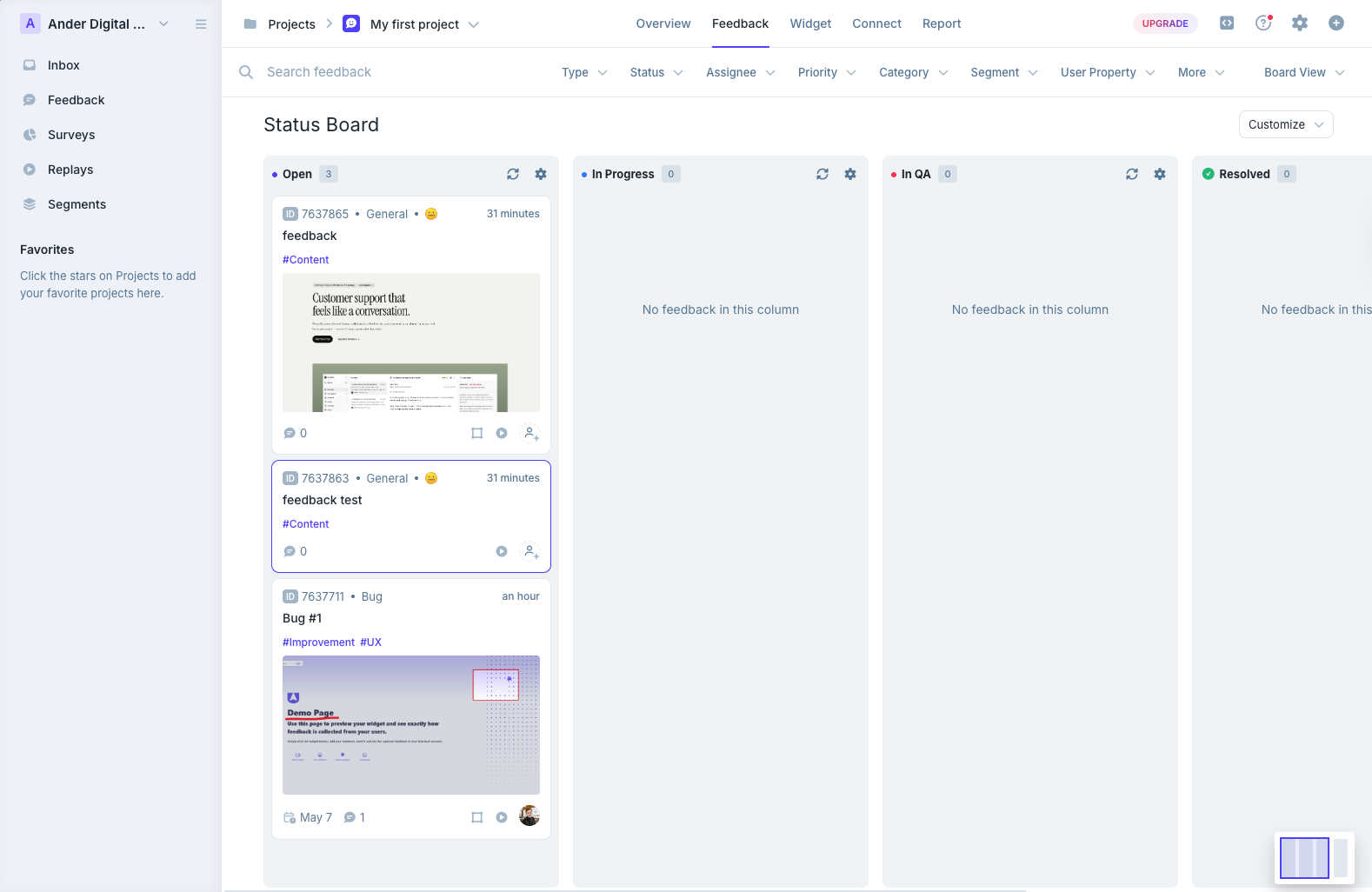
If part of what you liked about Ruttl was the kanban-style "all feedback in one tool" model, Userback is the closest like-for-like swap on this list. It sits in the same bucket as Marker.io and BugHerd: a layer between your website and your project management tool, with a heavy dashboard built around kanban boards and mailbox-style inboxes. Installation is clean. The depth shows up the moment you start using the dashboard.
That depth cuts both ways. The integration list is long, the triage views give you more options than most tools we tested, and once a team settles in the workflow is genuinely powerful.
The flip side is that it can feel like a lot for what most teams actually need. The dashboard stacks an inbox for mail-like notifications, a status board for tracking feedback, a project overview, and session replays on top of each other — and that range is overwhelming on day one. It is not a tool you pick up and immediately know how you want to work in.
The bigger gap showed up in screenshot handling. Not every comment gets a screenshot attached automatically, and when one is captured, it does not include a marker showing where the comment was placed. Placing a pin requires the reviewer to attach a screenshot in the same step. Compared to BugHerd or Feedbucket, where the pin and the screenshot location are tied together by default, that is a real gap for visual feedback work.
Like Marker.io, Userback also does not show existing comments on the page. Reviewers drop feedback in but cannot see what others have already flagged without opening the dashboard. On a live public site collecting passive feedback that is fine, since visitors are not comparing notes. On a staging site with a handful of reviewers, expect the same broken button to come in three times.
That decision shapes who this tool actually fits. Userback works for two profiles. The first is live websites collecting general user feedback about content. The second is larger companies running internal QA on staging sites, where the volume of feedback and the integration depth justify the dashboard. It is a poor fit for agencies and client review rounds, where the friction of a complex tool slows down the people you want most comfortable.
A small note on the brand: it is genuinely easy to confuse Userback with Usersnap. They are different products. If you are landing on one while searching for the other, that is normal.
The WordPress plugin follows the same pattern we have seen across most tools on this list: a script installer with no in-WP feedback management. If a deeper WordPress integration is on your shortlist, this is not it.
What Userback fixes versus Ruttl is the trust gap. The Free Forever tier lets you evaluate the product without a card, billing runs on standard self-serve flows, and the product cadence is public and active — the opposite of Ruttl's recent trajectory.
Key features:
- Long integration pool with major PM tools and Zapier
- Kanban-style boards and mailbox-style inbox for triaging feedback
- Session replay, user surveys, and behavioral targeting on Business and above
- AI Feedback and Insights on Business and above
- Mobile SDK, SSO, and REST API on Business Plus
Pricing:
- Free Forever (2 projects, 7-day feedback availability, max 2 seats, core features only)
- Team $7 per seat / month annually or $9 monthly (unlimited feedback availability, PM integrations, Zapier, customizable widgets)
- Business $15 per seat / month annually or $19 monthly (25 projects, session replay, JavaScript SDK, custom branding, AI Feedback and Insights)
- Business Plus $23 per seat / month annually or $29 monthly (unlimited projects, mobile SDK, SSO, REST API, webhooks, remove Userback logo)
Pros:
- One of the longest integration lists in this category
- Strong dashboard with kanban and inbox views for triaging
- Session replay and user surveys ship inside the same tool
- Free Forever tier exists, even if narrow — exactly the test-before-paying gate Ruttl refuses to offer
Cons:
- Per-seat pricing scales fast on real-world team sizes
- Not every comment gets an automatic screenshot
- Screenshots do not show a marker where the comment was placed
- Pin placement requires attaching a screenshot in the same step
- No on-page visibility of existing comments, which leads to duplicate reports on staging
- Feature depth makes it feel heavy for small teams or quick client reviews
- WordPress plugin is a script installer only, no in-WP feedback management
- REST API access is locked to the top Business Plus tier
- Easily confused with Usersnap, which is a different product
Reviews:
Public reviews trend strongly positive on the headline numbers: 4.8 for ease of use and 4.9 for customer service are the recurring averages. Users describe the tool as user-friendly and praise how efficiently it lets QA teams test registration flows and website components before launch. The simplicity of project setup and the routing menu come up repeatedly as strengths, and customer service gets singled out as one of the best in this category.
The recurring criticism is price and fit. Reviewers flag the seat-based pricing as expensive, and the most common technical complaint is that REST API access is locked behind the top tier, which puts it out of reach for smaller teams that want to script around the tool. A handful of reviews also note that the feature surface is more than they actually need, and that the simpler tools on this list end up being a better day-to-day fit.
Ybug#
Built for: QA teams · In-house product teams · SaaS teams
Best for: Internal QA and product teams that want a screenshot-to-ticket workflow with strong debugging data and EU data residency on every plan, including Free.
Ybug is the explicit EU pick on this shortlist. It is hosted in the EU, ships a GDPR-ready DPA on every plan including Free, and the consumer-protection issues that drove this entire post are not part of the picture — billing, cancellation, and refunds run on standard self-serve flows. If "an EU-based vendor so consumer protection is on your side without a fight" was the bullet that mattered most to you in the intro, this is the section to read closely.
Installation is via script tag or Chrome extension. Both are first-class — you can either embed Ybug on a site you control, or install the extension and capture feedback on any page you have access to. The widget is customizable per project (you decide which fields appear on each report), and permissions are granular at the project level, which is useful when you are separating clients, environments, or testing pools.
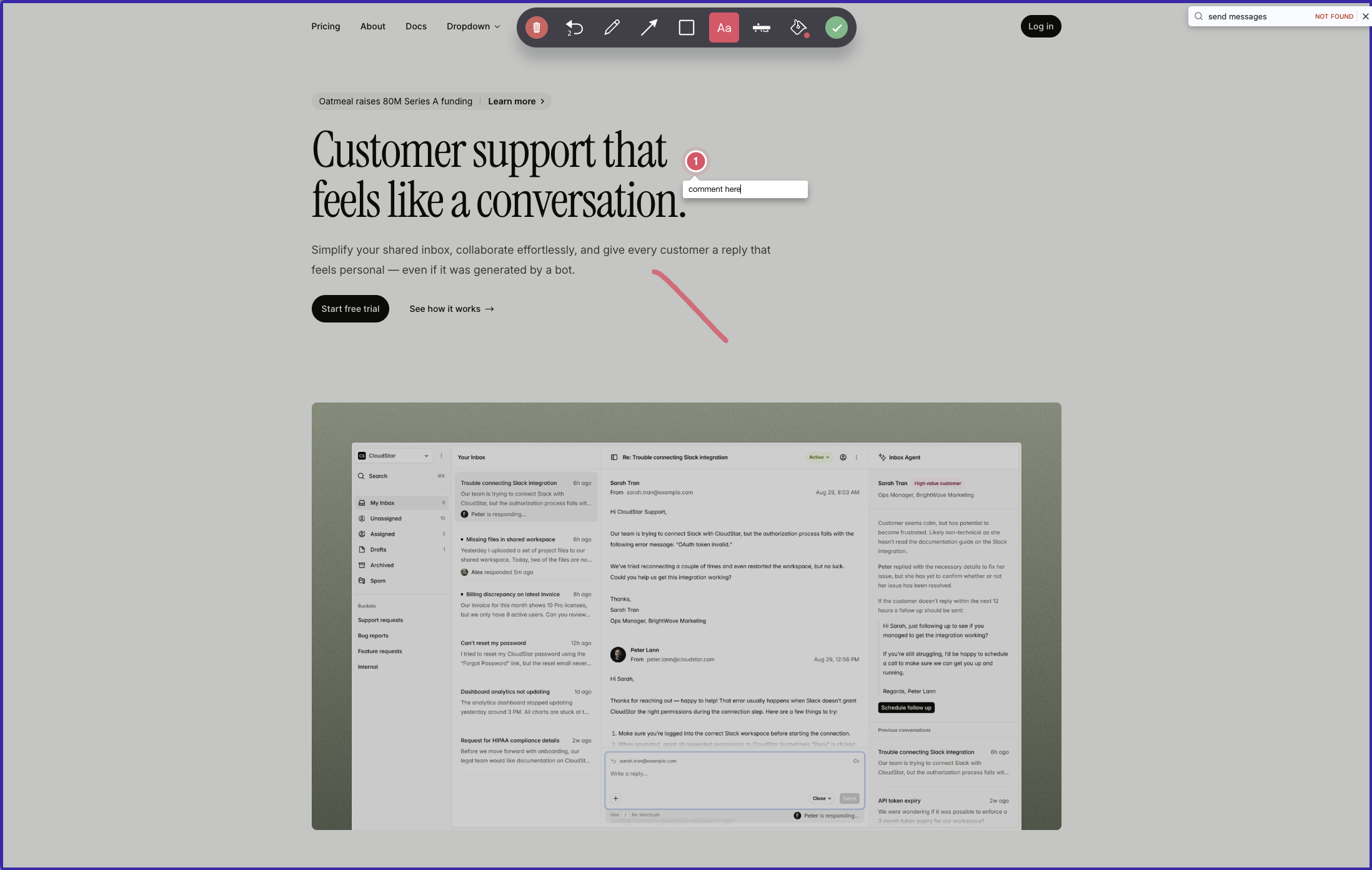
The interaction model matches Ruttl's free iframe flow more than the script-on-live-site flow. Reviewers open the widget and either submit feedback on the whole page or capture a screenshot. If they take the screenshot route, they can draw on it, annotate it, and pin comments to specific spots — but on the screenshot itself, not on the live page. The whole package becomes a ticket in Ybug's dashboard or, more commonly, in the PM tool you have connected. Pinned comments anchored to live elements that other reviewers see on the page is not what Ybug does.
Where Ybug earns its keep is the data attached to each ticket. Every report ships with annotated screenshots and automatic browser, OS, and screen-size metadata. Paid plans add JS console capture and error logs out of the box. The integrations catalog is one of the broadest on this list — 25+ destinations across PM, communication, support, and developer tools, plus Zapier and a webhook — though the sync is push-only, so status changes and assignments made in Jira or ClickUp do not flow back into Ybug.
Two friction points to flag honestly. First, every team member and stakeholder needs a Ybug account to see reports, which means the same login wall Userback has — Ybug does not fix that pain. Second, because reports are not surfaced on the live page, duplicate filings are normal on staging sites with multiple reviewers. Tier jumps are also steep because seats and projects are bundled (an eighth project pushes Startup at €23/mo into Company at €47/mo, even if the team has not grown), and white-label is still listed as "coming soon."
Key features:
- Script tag and Chrome browser extension install options
- Whole-page feedback or screenshot capture with on-image drawing, annotation, and pinned comments
- Customizable widget fields per project
- Granular project-level permissions
- JS console recording and automatic browser, OS, and screen-size metadata (paid tiers)
- Video recording and file attachments on Startup and above
- 25+ one-way integrations covering PM, communication, support, and dev tools, plus Zapier and webhooks
- EU-hosted with a GDPR-ready DPA on every plan, including Free
Pricing:
- Free €0/mo (1 project, 1 member, 50 screenshots)
- Basic €10/mo billed annually or €13/mo monthly (3 projects, 3 members, integrations limited to one per project)
- Startup €23/mo billed annually or €29/mo monthly (7 projects, 7 members, full integrations, video, file attachments, replies)
- Company €47/mo billed annually or €59/mo monthly (15 projects, 15 members, REST API, custom fields, custom branding)
- 10-day free trial, no credit card required
Pros:
- EU-hosted with GDPR-ready DPA on every plan, including Free — the direct fix for the consumer-law issues that shape this post
- Broad integration catalog covering PM, support, communication, Zapier, and webhooks
- Strong debugging data: annotated screenshots, console logs, environment metadata
- Granular project permissions for separating clients, environments, or testing pools
- Free tier is genuinely usable for solo or small-team work
- Support team consistently praised in reviews for sub-day response times
Cons:
- Comments are pinned to captured screenshots, not to live page elements — reviewers visiting the page later cannot see existing feedback
- Reviewers and team members must create a Ybug account to see or reply to feedback
- One-way integrations only — no two-way sync from your PM tool back into Ybug
- Custom branding is locked to the Company plan; white-label is still "coming soon"
- Tier jumps are steep because seats and projects are bundled together
Reviews:
Ybug has strong ratings on G2, with reviewers consistently highlighting how easy it is for non-technical reporters to file useful bug reports. Annotated screenshots, automatic environment data, and console logs are the standout features mentioned, especially for QA and UAT workflows. The support team gets called out often for fast turnaround, with multiple reviewers noting response times under one business day. The most common complaint matches what we hit in testing: reviewers and stakeholders need a Ybug account to see anything, which adds friction for client-facing or cross-team review work. For an internal QA team in a product org that already lives in a PM tool — and is happy treating Ybug as a screenshot-to-ticket pipeline with EU data residency baked in — it is well-rated. For teams that want a visual conversation pinned on the live page, this is a different shape of product.
Huddlekit#
Built for: Agencies · Freelancers
Best for: Agencies and freelancers reviewing WordPress, Squarespace, and Webflow sites. A weak fit for SaaS apps or teams with stricter security needs.
Huddlekit launched in 2025 and the team has been shipping at a fast clip. Installation is one of the smoothest we tested — the iframe loaded cleanly, we were up and running in minutes, and we hit very few bugs across testing. For a tool this new, that polish stands out.
The standout feature is the four-screen responsive canvas. Huddlekit shows a project at mobile, tablet, laptop, and desktop sizes side by side, all in one view. No other iframe tool on this list ships anything close. For agencies working on marketing sites where responsive testing is genuinely critical, that's a real differentiator. You catch a misaligned hero on mobile and a stretched headline on desktop in the same review pass, no bouncing between viewports.
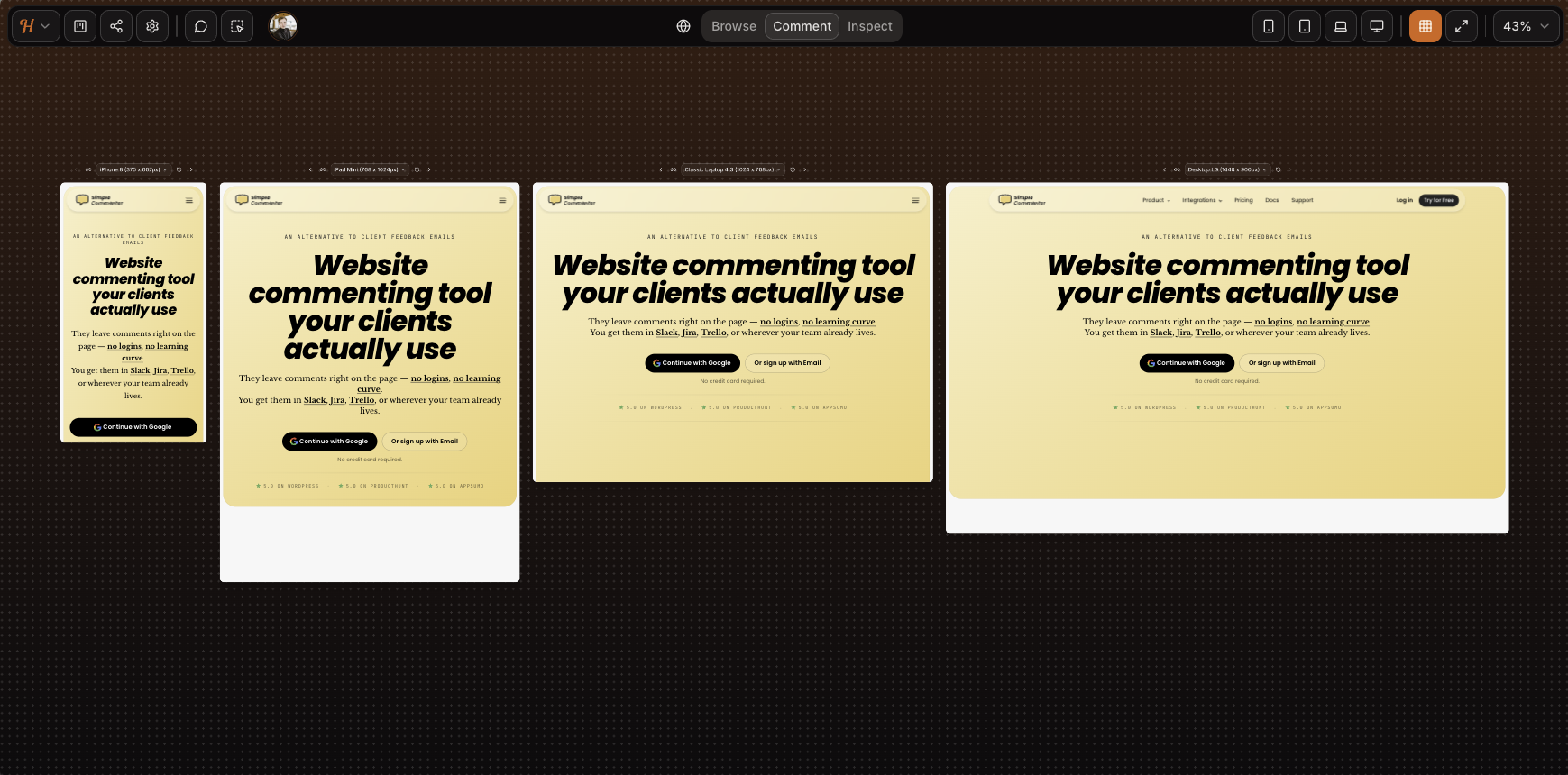
The iframe trade-offs we've covered across the rest of this page still apply. Mobile feedback runs through a desktop-emulated viewport rather than a real device — as you can see from the screenshot, the SVG animation on our homepage is missing entirely. Complex authenticated apps won't load inside the canvas, and although iframe tools can sometimes be configured to get past Basic Auth, Huddlekit doesn't support that yet. Our test page behind auth wouldn't load. If you're reviewing a marketing site or a CMS-built page on WordPress, Squarespace, or Webflow, the iframe is fine. For a SaaS product or anything behind a login, expect the friction.
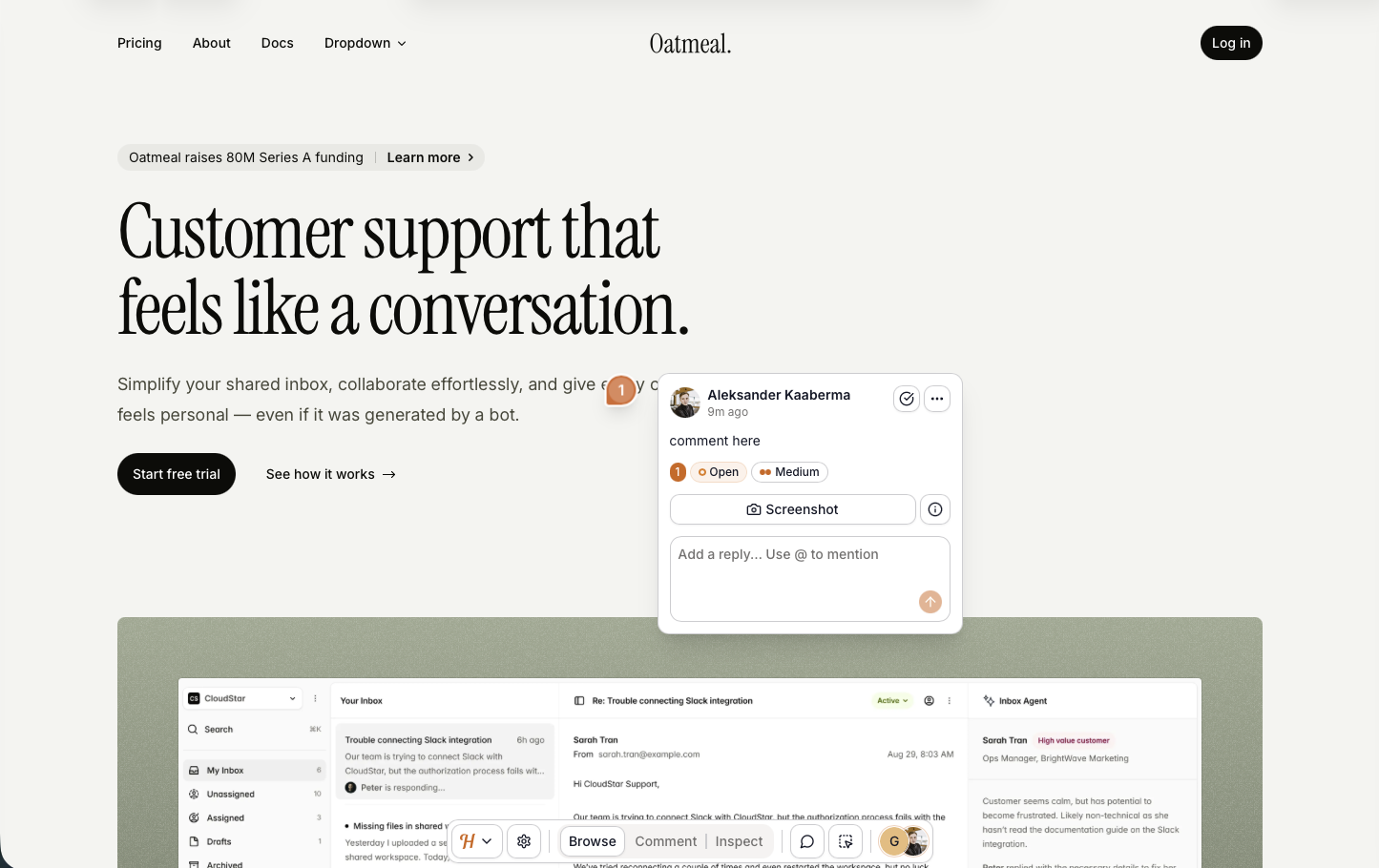
Script loading is the second install path, currently in beta. On our test pages it worked well — setup was clean, every comment captured an automatic screenshot, and crucially the screenshot landed on the actual spot the comment was placed (a real gap on tools like Markup, where it sometimes captures the wrong part of the page). It's close to ready to leave beta. The rough edges still show up on more complex elements like dropdowns and drawers.
Sharing is straightforward on either path. The iframe hands you a public link; the script flow on a live site is parameter-only. Neither path layers in login-gated access, so anyone with the link can open the project and read existing feedback. Leaving a comment is the only gated step, and Huddlekit asks for a name and email rather than a full account. Lightweight — but not anonymous.
Email-based auto-association also means anyone who knows a team email can comment as that member. For freelancers and small agencies, that's a fair simplicity-for-security trade. For larger corporations that need login-gated access, audit trails, or control over who can see feedback at all, it falls short. The pricing tiers cap at "Agency", which signals enterprise isn't the target.
The integration story is the other gap. There are no integrations live yet. The marketing leans into the positioning, pitching explicitly against a "screenshot-and-Slack workflow." The kanban board doubles down on the same idea: Huddlekit wants to be your PM tool, not pipe into one. That works for teams with no existing tracker. Most agencies and larger companies already live in Jira, Trello, or ClickUp, and managing feedback in a second tool with no two-way sync is a real ask.
White-labeling isn't available on any tier. Every comment, shared link, and dashboard view carries the Huddlekit logo, which is a real consideration for agencies handing work to clients under their own branding.
Key features:
- Iframe-based feedback with script loading in beta
- Four-screen responsive view (mobile, tablet, laptop, desktop side by side)
- Media commenting (images, PDFs, video) alongside web pages
- Automatic screenshot on every comment
- Kanban board, comment pausing, private comments, inspect mode on every paid tier
- Public-mode widget loading for live-site feedback
- Forever free tier suited to solo work
Pricing:
- Free tier (3 team members, 1 project, 100 MB storage, 2 MB image/PDF, 10 MB video), suited for solo and side projects
- Pro $19/mo, $190/year (3 team members, unlimited projects, unlimited guests, 5 GB storage, unlimited custom tags, 50 MB image/PDF, 500 MB video)
- Team $39/mo, $390/year (15 team members, unlimited projects, unlimited guests, 50 GB storage, unlimited custom tags, 250 MB image/PDF, 2 GB video)
- Two months free on yearly billing
Pros:
- Smooth installation and a polished feel for a tool this new, with very few bugs in our testing
- Four-screen responsive view (mobile, tablet, laptop, desktop side by side) is unique to Huddlekit in this category
- Script loading works well even in beta, with screenshots captured from the correct spot — better than several incumbents we tested
- Forever free tier, genuinely usable for solo work
- Public-mode widget is a clean fit for live-site feedback collection
- Automatic screenshot on every comment
- Kanban, comment pausing, private comments, and inspect mode included from Pro
- Active development cadence
- Simple sharing on either install path
Cons:
- Iframe model breaks on Basic Auth, authenticated SaaS, and pages that refuse to render in iframes
- Mobile feedback is desktop-emulated, not real-device
- Anyone with the link can open the project and read existing feedback — no view-level access control, gating only kicks in when leaving a comment
- Every comment requires a name and email, so there is no fully anonymous flow
- No integrations
- No white-label or custom branding on any tier
- Security model is not a fit for enterprise compliance needs
- No third-party reviews on G2, Capterra, or Product Hunt yet to verify the tool's rating
Reviews:
The Huddlekit site shows a 5/5 rating, but we couldn't find third-party reviews on G2, Capterra, or Product Hunt to triangulate against. The on-page testimonials line up with what we saw in testing: a clean iframe experience, fast iteration, and a viable alternative to Markup.io, Pastel, and Ruttl for asset review on simple sites.
Same caveat as BugSmash applies — a full assessment has to wait until subscriber reviews land on G2 or Capterra. For now, though, Huddlekit looks promising: the same iframe feature set as the incumbents, an active dev cadence, and a script-loading path that already outperforms several of them in our testing. The beta label isn't a reason to hold off — it's already good enough to lean on, which puts Huddlekit in the more versatile-install category we recommend.
MarkUp.io#
Built for: Agencies · Freelancers
Best for: Design agencies reviewing client work on WordPress or Squarespace. Hard to recommend for Basic Auth sites or teams that want to test before paying.
Markup.io falls in the same bucket as Ruttl: you can't test the tool fully without handing over a card. There's no free tier and no card-free trial, which makes evaluating it before commitment a real pain. We paid for it, so this section is based on actual hands-on time, not just marketing copy.
Installation has two paths. The first is the proxy: paste a URL into Markup.io and it serves your site through a Markup-hosted address that reviewers comment on. Convenient because there's no script to embed — the catch is that any site protected by Basic Auth won't load through the proxy.
The second path is the Chrome extension, which runs on the live page and is the better of the two experiences. It does ship a visible bug: hovering on the page draws a border around every div under the cursor. That said, it's a more useful extension than the ones from Pastel and Volley. Markup's extension is a full overlay that makes the live site commentable, where Pastel's only spins up a new canvas.
The downside is one we've seen across reviews of every extension-first tool: onboarding clients is hard. Asking a stakeholder to install a browser extension before they can leave a single comment is friction most clients won't push through. There's no mobile feedback path either, since the extension only runs on desktop Chrome.
Every comment is supposed to ship with an automatic screenshot, but in our testing the screenshot was captured from a completely different spot than where the comment was placed. That's not a small bug for a tool whose main capture format is a screenshot.
The integration list is short for a tool at this price. Zapier, Slack, Microsoft Teams, Loom, and a Chrome extension. ClickUp is still listed as "coming soon." There's no Jira, Linear, Asana, Trello, or webhook story beyond Zapier. The dashboard is bare-bones and the settings are minimal. Their public roadmap lists more integrations as a future item, and across all of 2025 the team shipped only six features. For a tool that's been around for years and has a sizeable user base, the pace of product work is hard to reconcile with the price.
Pricing is the strongest pitch in the offer. One Pro plan at $79/mo: unlimited users, one workspace, unlimited markups, 500 GB storage, folders, and shareable links. No per-seat math. Genuinely useful for larger teams, but for smaller teams or solo reviewers, $79/mo with no entry tier is a steep starting point compared to tools on this page that start at $29 to $39.
Key features:
- Proxy-based review (no script required) plus a Chrome extension for live-page commenting
- Automatic screenshot on every comment
- Unlimited users on a single flat plan
- Folders, shareable links, and basic workspace management
- Loom integration for video and screen recordings inside comments
Pricing:
- Pro $79/mo (unlimited users, 1 workspace, unlimited markups, 500 GB storage)
- No free tier, credit card required to create an account
- No free trial without payment details
Pros:
- Flat pricing with unlimited users, no per-seat scaling
- Two install paths: proxy (no script) or Chrome extension
- Loom integration ships out of the box
Cons:
- Paid-only with a credit card required just to create an account
- Screenshots captured from the wrong spot on the page in our testing
- Chrome extension draws a border around every div on hover, looks unfinished
- Proxy mode does not work on sites behind Basic Auth
- Short integration list (Zapier, Slack, Teams, Loom, Chrome extension); ClickUp still "coming soon"
- Bare-bones dashboard with limited settings
- Slow pace of product development: roughly six features shipped across all of 2025
- $79/mo entry price is steep for smaller teams compared to alternatives at $29–$39
Reviews:
G2 reviews skew positive overall, and the recurring praise lands on the same handful of points: ease of use, self-service setup with no sales call, and how quickly non-technical clients pick the tool up on first use. Agencies and freelance designers in particular describe it as the kind of tool you can hand to a client and trust them to leave useful, in-context feedback. Reviewers also call out the rich-text commenting, shareable links, and the ability to review across desktop, tablet, and mobile in the browser as features that keep them on the platform.
The criticism is consistent and lines up with what we ran into during testing. Pricing is the most common complaint, with multiple reviewers saying the single-tier pricing is too steep for most use cases. Reviews flag specific gaps that still haven't been addressed: data is locked inside the platform with no export, the Zapier integration doesn't support historical sync, and page load times can be slow inside the proxy view.
A note on review freshness: a chunk of the public reviews date back to early 2023 and reference a free tier with unlimited users that no longer exists. Since then, the pricing model has tightened, and reviews from 2024 and 2025 spend more time on what's missing than on how generous the old free plan was. Combine the slowed product cadence, the price increase, the Basic Auth gap on the proxy, and the screenshot bug we hit, and the reviews land where you'd expect: the tool still gets the basic job done, but it's no longer the obvious pick it was three years ago.
Which one should you pick?#
If your reason for leaving Ruttl is the paid-features-are-broken story, Simple Commenter and Feedbucket are the cleanest live-site script swaps — both ship the 14-day card-free trial Ruttl refuses to offer on the script tier, and both have working integrations. If the kanban-style "all feedback in one tool" workflow was the draw and you want a polished version with active product development, Userback is the closest like-for-like swap. If EU consumer protection and GDPR-ready data residency are the bullets that mattered most to you, Ybug is the explicit pick — EU-hosted with a DPA on every plan, including Free. If you liked Ruttl's free iframe flow and just want to stay on that model with a tool that actually maintains the product, Pastel is the mature option and Huddlekit is the polished newcomer with the four-screen responsive view. And if your team is large enough that flat pricing for unlimited users wins on math, MarkUp.io is the largest install base in that shape.
Found this useful? Add us as a preferred source and Google will show you more of our guides in Search and AI Overviews.